
Spark AI Foundry touts plan for Loveland data center
LOVELAND – A company that is building a national network of data centers on a terabyte network core may be working to establishing one in Loveland. Its website lists three sites, including Loveland. It is looking to add 17 more across the country.
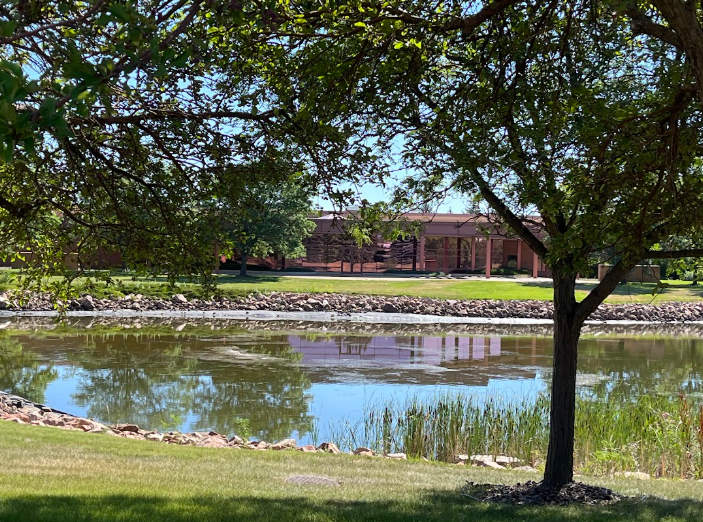
Spark AI Foundry, a company not registered in Colorado but affiliated with Spark Data Center Services LLC, which may have offices in the Chicago metro area although it isn’t registered there either, touts on its website that the Loveland location in the former Woodward Inc. facility at 3800 N. Wilson Ave. is part of its “continental grid of high-performance computer sites.” The other two in the network so far are in Olathe, Kansas, and Lansing Township, Michigan.
The status of the Loveland data center is not clear. Loveland’s planning department said in an email to BizWest that “a company has contacted city staff with interest in establishing a data center in Loveland. However, we have no applications at this time and therefore cannot offer any concrete details about potential impacts of a project. A City Council work session on data centers is planned for Sept. 1, 2026, where the topic of data centers will be discussed in detail,” the city statement said. The city later wrote in an email that “a business cannot establish a data center without an approved application through the development review process.” That process has not occurred, the city said.
Mayor Patrick McFall did not return a call seeking further information.
Meanwhile, the Platte River Power Authority, which is the wholesale supplier of electricity for Loveland, Fort Collins, Longmont and Estes Park, determined in a study of its resources that a site in Longmont could accommodate a 50 megawatt use without any additional infrastructure, and the Woodward site in Loveland could handle a 15 MW use but would need additional infrastructure for more.
PRPA spokesperson Kendal Perez told BizWest that the electrical power provider also has not received any direct requests for the power that it would take to run a data center. “But the cities have received these requests,” she said, and that’s the route that such proposals would take.
In preparation for such large requests, Perez said PRPA approved a “large load policy to use as a guide” in December 2025. The guide helps the utility “avoid rate increases to other customers and maintain equity among the four community partners.”
A data center of the type under consideration around the country typically requires about 250 MW or even gigawatts of power. In some cases, developers add 100 MW at a time as a center ramps up its services, according to a site developer who appeared at a workshop in Greeley in May.
Exactly what the Spark AI company does is not clear, although its website says it is building an “infrastructure backbone for the AI era.”
“These sites are being developed as part of Spark AI’s Neocloud architecture, delivering scalable, power-dense infrastructure that supports the full range of modern AI workloads: from frontier model training to real-time inference, enterprise AI applications, and research computing,” the website says.
“Each Foundry site is engineered for the demands of AI infrastructure: high power density, redundant fiber interconnect, and operational excellence, forming a distributed computer fabric across the continent.”
Jack Pressman, company chief technology officer, did not respond to a call seeking additional information.
The company is seeking partners. It lists three partners already, among them Datacenter.com, which is a colocation center in Amsterdam. Also listed is Deep Green, a company that builds data centers using “waterless cooling” and donates waste heat to local communities. It is developing the Lansing site. A third partner is Aerico, a data center design consulting firm.
The Deep Green resources may be particularly important to the company’s operations in Colorado, where concerns about massive water and electrical use are causing numerous communities to place moratoriums on development of data centers. Those moratoriums include Longmont, Broomfield, Fort Collins, Boulder, Denver and Larimer County. Weld had a moratorium but voted in April to approve rules for their establishment on unincorporated land of the county.
An entity formed by New York-based GlobalAI Cloud Inc. that builds AI data centers acquired the dormant, 438-acre Carestream Health Inc. property in unincorporated Weld County in December. Vima OZ LLC, an entity controlled by Windsor developer Martin Lind, which bought the property last May for $3.5 million, closed Nov. 26 on the $15.6 million sale.
In May, BizWest reported about the potential impacts and benefits of large-scale data centers. Speakers at the Confluence water and energy conference, including data center developers and utility operators, said that new technology permits data centers to use perhaps 2 million gallons of water at startup but then recycle the water for continued cooling of the computer racks. Utility operators said they attempt to structure power agreements so that data center electrical draw does not impact other consumers in the network. Some communities also have discussed requiring data centers to bring their own power resources.
In the case of the existing industrial facility at 3800 Wilson Ave., which is owned by Southgate One LLC, a company affiliated with Windsor developer Lind, a large amount of power is already available because of its prior use by Woodward. The site, 38.467 acres, includes 221,366 square feet of space across four buildings. The largest structure at 102,271 square feet was used as an engineering center. A nearly 9,000-square-foot manufacturing facility is on the site as well as a smaller service garage and warehouse.
The property is zoned “developing industrial.”
Lind did not return a call seeking clarification about the status of the property.
Data center development often tops the discussion at city halls and statehouses around the country because of the potential impacts and benefits. States have wrestled with whether to offer incentives to such companies. Wyoming, especially Cheyenne and Laramie County, has embraced the economic opportunities that they offer. Near Cheyenne, companies have established 12 operating centers, are building five more and 43 additional projects have been announced. One of them will be 4 million square feet spread across multiple 500,000-square-foot buildings, all powered by on-site natural gas electrical generators.
Hans Rodvik, Northern Colorado manager for Xcel Energy, said in October 2025 that the potential impact of data centers is massive. “The data-center proposals we have are equal to our entire current system,” he said of the multi-state utility with headquarters in Minnesota.
Nationwide, there are 1,218 facilities in one stage or another of development; 796 are operational. Colorado has 27, mostly in the Denver metro area.
Virginia has the most data centers in the country, followed by Texas and Arizona.
This article was first published by BizWest, an independent news organization, and is published under a license agreement. © 2026 BizWest Media LLC.
A company that is building a national network of data centers on a terabyte network core is establishing one in Loveland.

Related Posts
-
Walmart is working to install millions of dollars worth of technology at the Loveland distribution…
-
Related Digital, a vertically integrated data-center development and investment platform, broke ground Tuesday on a…
-

The Lincoln Center’s Cozy Coats pet-supply drive, benefiting The Street Dog Coalition, will take place…
-
The town of Johnstown and McWhinney Real Estate Services Inc. have awarded $10,000 to the…
